


Who Is Responsible for Employees in a Labour Outsourcing Agreement?
When a business uses labour outsourcing, one of the first questions management may ask is: Who is responsible for the outsourced employees?
Is it the labour outsourcing company that recruited and pays the workers, or the client company where they perform their daily duties?
In South Africa, the answer depends on the nature and duration of the placement, the employee’s earnings, the applicable legislation and the terms of the labour outsourcing agreement. In practice, both the Temporary Employment Service and the client have important responsibilities.
Understanding these responsibilities can help businesses protect employees, maintain compliance and avoid the classic workplace problem of everyone pointing across the room and saying, “That belongs to them.”
What Is a Labour Outsourcing Agreement?
A labour outsourcing agreement is an arrangement in which a company obtains employees through a labour outsourcing provider, commonly referred to as a Temporary Employment Service, or TES.
The TES recruits and places employees at the client’s workplace to perform agreed services. Depending on the arrangement, the TES may also manage:
- Employment contracts
- Payroll administration
- Leave records
- Statutory deductions
- Employee documentation
- Disciplinary procedures
- Industrial relations matters
- Bargaining council administration
The client generally manages the employee’s daily operational activities, workplace access, job-specific instructions and performance requirements.
Is the Labour Outsourcing Company the Employer?
Under section 198 of the Labour Relations Act, a Temporary Employment Service is regarded as the employer of employees whom it places with a client, subject to the additional protections contained in section 198A.
For a genuine temporary placement, the TES will ordinarily remain responsible for the formal employment relationship. This may include issuing employment contracts, paying employees, processing statutory deductions and managing employment-related administration.
However, this does not mean that the client has no responsibility for the outsourced employees.
South African labour legislation places certain obligations on both the TES and the client. In some circumstances, they may be held jointly and severally liable for particular employment-related contraventions. This means an affected employee may be able to claim against the TES, the client, or both, depending on the circumstances.
What Happens After Three Months?
Section 198A of the Labour Relations Act provides additional protection to certain lower-earning employees placed through a TES.
Where an employee is not performing a legally recognised temporary service and has worked for the client for longer than three months, the employee may be deemed to be an employee of the client for purposes of the Labour Relations Act.
A temporary service generally includes:
- A placement lasting no longer than three months
- Replacing a client employee who is temporarily absent
- Work classified as temporary by a collective agreement, bargaining council agreement or sectoral determination
In the 2018 Assign Services Constitutional Court judgment, the Court confirmed that qualifying employees who are placed for longer than three months and are not performing a temporary service are deemed to be employees of the client for purposes of the Labour Relations Act.
This is sometimes described as the “sole employer” interpretation. It does not necessarily mean that the TES can no longer provide payroll, administrative or human resources support. It means that the client carries the relevant employer responsibilities under the Labour Relations Act for the deemed employee.
The rules must be considered carefully because their application can depend on the employee’s earnings, the nature of the work and the reason for the placement.
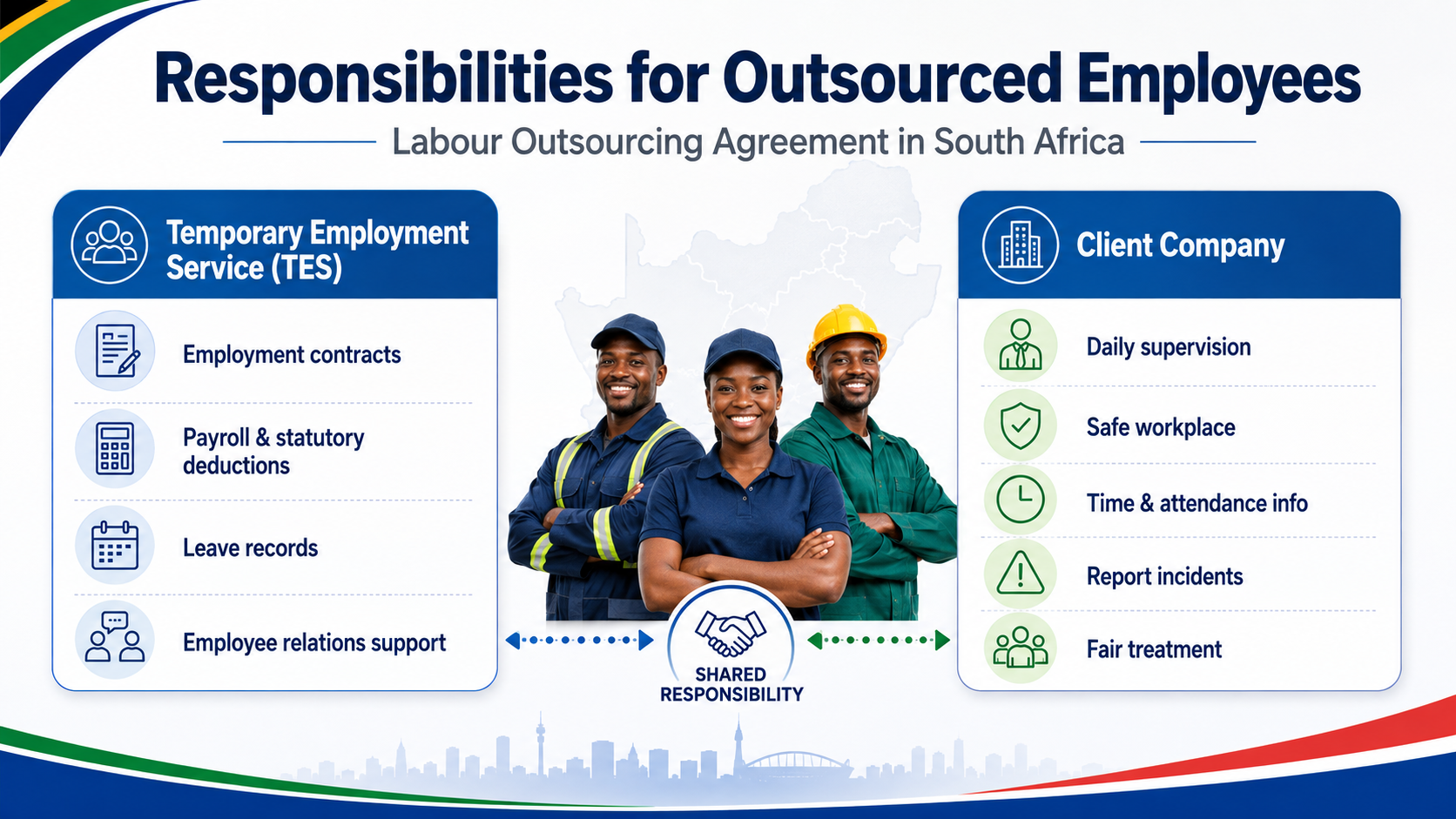
Responsibilities of the Labour Outsourcing Provider
A reputable labour outsourcing provider should ensure that employees are properly appointed, paid and administered.
Depending on the service agreement and legal status of the placement, the TES may be responsible for:
Employment contracts
Employees should receive clear written employment contracts setting out their position, remuneration, working hours, placement and other employment conditions.
Payroll and statutory deductions
The outsourcing provider may calculate wages, issue payslips and process deductions or contributions relating to PAYE, UIF and other applicable statutory requirements.
Leave and attendance administration
The TES may maintain leave records, attendance information and supporting employee documentation, provided that accurate information is supplied by the client.
Employee relations support
The provider may assist with grievances, misconduct, absenteeism, incapacity and disciplinary procedures.
Any disciplinary action must still follow a fair process and comply with the Labour Relations Act, applicable codes of good practice, collective agreements and company procedures.
Bargaining council compliance
Where employees fall within the scope of a bargaining council, the TES may assist with registrations, returns, contributions and compliance with the applicable collective agreement.
Employment documentation
The outsourcing provider should maintain appropriate employee records and process personal information in accordance with the Protection of Personal Information Act.
Responsibilities of the Client Company
Although the TES manages many employment functions, the client remains responsible for what happens at its workplace.
The client’s responsibilities commonly include:
Providing a safe working environment
The client controls the premises and must take reasonable steps to provide a workplace that is safe and without unnecessary risks to employees’ health.
Outsourced employees should receive relevant inductions, personal protective equipment, emergency information and job-specific safety instructions where required.
A safety rule does not become optional merely because the employee’s name appears on another company’s payroll.
Daily supervision and work instructions
The client normally determines:
- Where the employee will work
- What duties must be completed
- How the work must be performed
- Which operational procedures apply
- Who supervises the employee
- What production or service standards must be met
Instructions must be lawful, reasonable and consistent with the employee’s role.
Accurate time and attendance information
Where the TES processes payroll, the client must provide accurate information relating to hours worked, overtime, shifts, absences and approved leave.
Incorrect information can lead to incorrect wages and potential disputes.
Reporting workplace incidents
Accidents, misconduct, poor performance, absenteeism and other employee-related matters should be reported promptly to the TES.
Clients should avoid informally dismissing or removing an outsourced employee without consulting the TES and following an appropriate process.
Fair treatment
Outsourced employees must be treated fairly and with dignity. They should not be subjected to harassment, discrimination or unfair treatment because they have been placed through an outsourcing provider.
Qualifying deemed employees must generally not be treated less favourably than comparable employees of the client who perform the same or similar work, unless there is a justifiable reason for the difference.
Can the Client Simply Tell the TES to Dismiss an Employee?
A client should not assume that it can dismiss an outsourced employee simply by asking the TES to remove that person from the workplace.
Removing an employee from a placement and terminating the employee’s employment are not always the same thing.
An employee may still have protection against unfair dismissal. Contractual clauses that automatically end employment when a client terminates a placement may be challenged where they attempt to bypass the employee’s labour-law rights.
Where there is misconduct, poor performance, incapacity or an operational requirement, the matter should be investigated and handled through a lawful and procedurally fair process.
The TES and client should communicate before action is taken and determine:
- What happened
- Which policy or rule applies
- Who should investigate the matter
- Whether the employee must be suspended or removed temporarily
- What procedure must be followed
- Which party will chair or manage the process
Why the Labour Outsourcing Agreement Matters
A properly drafted labour outsourcing agreement should clearly divide the responsibilities of the client and the TES.
The agreement should address matters such as:
- Recruitment and employee screening
- Employment contracts
- Payroll responsibilities
- Working hours and overtime approval
- Leave administration
- Health and safety
- Personal protective equipment
- Supervision and performance management
- Disciplinary procedures
- Workplace injuries
- Bargaining council obligations
- Confidentiality and personal information
- Termination of assignments
- Dispute management
- Indemnities and legal liability
However, a contract cannot remove rights granted to employees by legislation. Writing “the other party is responsible” into an agreement will not override the Labour Relations Act, the Basic Conditions of Employment Act or occupational health and safety requirements.
Shared Responsibility Requires Clear Communication
A successful labour outsourcing arrangement is not a handover-and-forget exercise.
The TES brings employment administration, payroll systems, labour-relations knowledge and workforce support. The client provides the operational environment, daily supervision and workplace controls.
Both parties should communicate regularly and maintain clear processes for:
- Reporting attendance
- Approving overtime
- Managing leave
- Addressing misconduct
- Monitoring performance
- Reporting workplace incidents
- Updating employee information
- Responding to complaints and grievances
When responsibilities are clear, outsourced employees receive better support and the client gains a more reliable and compliant workforce solution.
Choose a Reputable Labour Outsourcing Partner
The question is not only who is responsible for outsourced employees. Businesses should also ask whether their labour outsourcing partner has the systems and expertise to fulfil its responsibilities properly.
A reputable TES can help businesses manage workforce administration, payroll, employee relations and labour compliance while allowing management to focus on core operations.
Assign Services provides flexible labour outsourcing solutions supported by payroll administration, human resources assistance, industrial relations support and bargaining council administration.
Disclaimer: This article provides general information and does not constitute legal advice. Labour outsourcing arrangements should be assessed according to their specific facts, applicable legislation, collective agreements and contractual terms.
